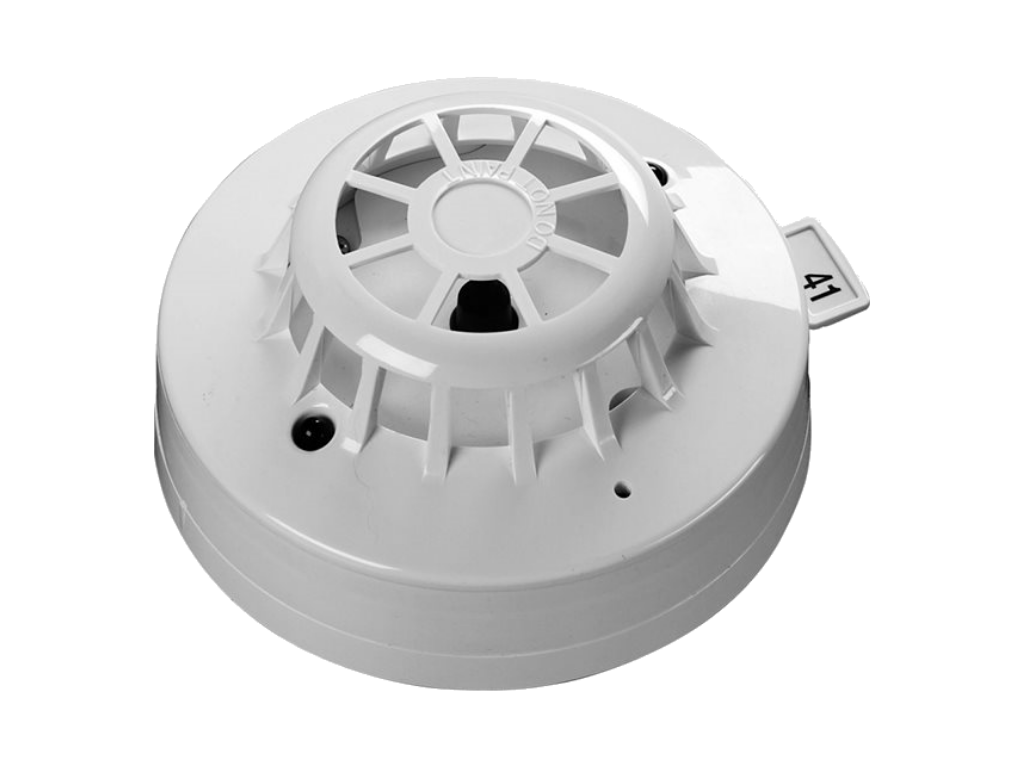
The Discovery Marine Heat Detector uses a single thermistor to sense the air temperature at the detector position. The thermistor is connected in a resistor network, which produces a voltage output dependent on temperature. The design of the resistor network, together with the processing algorithm in the microcontroller, gives an approximately linear characteristic from 10°C to 80°C. This linearised signal is further processed, depending on the response mode selected, and converted to an analogue output.
- Approved for use in the marine environment.
- Five response modes for environmental adaptation.
- Day/night switching for increased flexibility.
- Drift compensation for false alarm reduction.
- User programmability for data.
- XPERT card addressing for increased security.
Certification: ESC, MED, BV, ABS, LR, VNIIPO, KRS, DNV.GL & CCS
The Discovery Marine Heat Detector uses a single thermistor to sense the air temperature at the detector position. The thermistor is connected in a resistor network, which produces a voltage output dependent on temperature. The design of the resistor network, together with the processing algorithm in the microcontroller, gives an approximately linear characteristic from 10°C to 80°C. This linearised signal is further processed, depending on the response mode selected, and converted to an analogue output.
- Approved for use in the marine environment.
- Five response modes for environmental adaptation.
- Day/night switching for increased flexibility.
- Drift compensation for false alarm reduction.
- User programmability for data.
- XPERT card addressing for increased security.
Certification: ESC, MED, BV, ABS, LR, VNIIPO, KRS, DNV.GL & CCS